

Surviving Winter Brain Fog
Solie Lawson |Feb. 3, 2026
Winter on campus, while having the benefits of snow and colorful scarves, also brings a lack of motivation, or, known by its more common name, brain fog. After Warren Wilson College (WWC) students returned from a month-long winter break, many feel restless and unexcited to return to new classes.
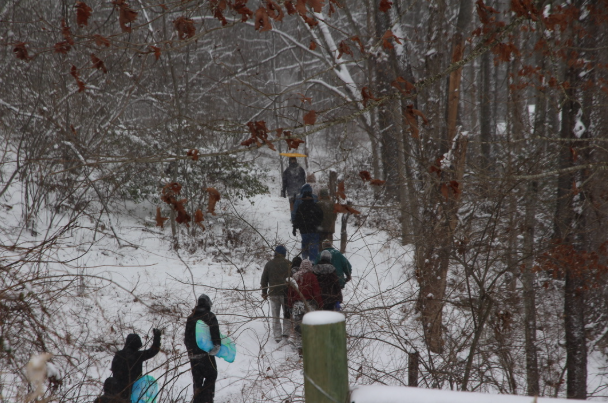
Groups of WWC students hike snowy forest trails around Dogwood Pasture in Swannanoa, N.C., Jan. 31, 2026. (Vivian Bryan/Echo)
For Gus Policelli, a freshman on Cowpie Crew, returning to the busy school schedule has proved difficult so far. He feels that this is a recurring issue, especially with the end of last semester.
“Towards the end of the [fall] semester, I felt pretty overwhelmed,” Policelli said. “I'd have a huge to-do list in front of me, and I'd spend hours doing nothing and just staring at the work.”
Policelli described how his brain fog is the worst in his morning classes, making it hard to process information so soon after waking up. Policelli felt that being taught first thing in the morning does not work for him because his brain has not fully woken up and therefore, he struggles to learn. The morning brain fog, combined with the lack of motivation produced from the cold weather, makes obtaining knowledge all the more difficult.
“I always have a lot more responsibilities in the winter, but also everything feels a lot more bleak, and it's harder to get work done,” Policelli said.
Moving forward, Policelli has measures in place to achieve his goals and maintain motivation. He believes that making a routine is a process that takes time. Policelli stressed that while there are short-term fixes to his brain fog, such as caffeine, he wants to continue to strive towards better long-term fixes.
Hailey Rees, a freshman on Cowpie Crew, takes a similar stance to Policelli on brain fog. She says she feels that brain fog is similar to sleepwalking, producing mindless movement. Rees described how forcing herself to get ready immediately after she wakes up makes her more productive throughout the day.
Despite this helpful routine, she does sometimes find herself spacing out in class and having difficulties processing information due to the lack of motivation that began for her after winter break.
“I'll sit in class, and I'll pay attention, but then I’ll leave class, and I’m like, ‘What?’” Rees said.
Although being back on campus has been hard academically, Rees did emphasize how excited she was to see friends and continue connecting with her peers. For her, brain fog is more intense in her academic life than in her social interactions.
Freshman Rosemary Richesin-Dodd on the Library Crew finds brain fog to be less of a seasonal phenomenon and more connected to how the human brain processes information. In the age of social media, she thinks, information comes in 60-second intervals, making it harder to process important information.
“When you're receiving all of this constant simulation from the short-form informational videos, it's way harder for you to have to sit down with concepts that have a lot more depth to them,” Richesin-Dodd said.
While Richesin-Dodd believes that brain fog is not a seasonal thing, she also thinks that winter and mental health issues can exacerbate a lack of motivation and mental health problems in her peers. Her solution is to push herself to be more intellectually challenged throughout the day and rely on less entertainment through social media.
“Putting time and effort into being more intellectual and also cutting down on short-form content and getting back into being able to have an attention span to appreciate concepts that require more [attention],” Richesin-Dodd said.
While brain fog can feel paralyzing and unsolvable, students stressed that finding a personal routine and choosing not to rely on entertainment can help. Although winter brings a need to remain indoors, students can still push themselves to be more intellectual and purposeful in their own ways. Whether by getting up early, striving to find a routine or finding an activity that requires patience, students can find a way to escape the exhaustion that comes from brain fog.